September 15, 2026

If the first article in this series focused on reducing the tax base (expenses and depreciation), this one covers the incentive that provides the highest after-tax return for many investors: the reduction under Article 23.2 of the Personal Income Tax Law (LIRPF) on net rental income from primary residences. For years, this was a flat, generous 60% reduction. Law 12/2023 (the Housing Law) completely reconfigured it, making it conditional on the contract date and a series of requirements, creating a range of tiers that now spans from 50% to 90%.
For the real estate investor, understanding this reduction is not optional: it is the difference between paying taxes on almost all of your net income or only a small fraction of it. In this article, we break down each tier, its exact requirements (verified against the official Spanish Tax Agency chart), the key factor of "stressed areas," how it interacts with expenses and depreciation, and its real impact on your tax bill and profitability.
General technical information, not tax advice. The tiers are based on the official AEAT chart (Art. 23.2 LIRPF, reductions applicable in 2024). Verify the current status and your specific situation with an advisor and the AEAT.
It is a reduction applied to the net income derived from renting out properties intended for housing—the tenant's permanent primary residence. It is not a tax credit or an expense; it is a percentage subtracted from the net income already calculated (after expenses and depreciation) before it is added to the general tax base. It is regulated under Article 23.2 of the Personal Income Tax Law.
Three cross-cutting conditions, essential for all tiers:
The reduction percentage depends on the contract date and compliance with requirements. This is the chart, according to the Tax Agency, for reductions applicable in 2024:
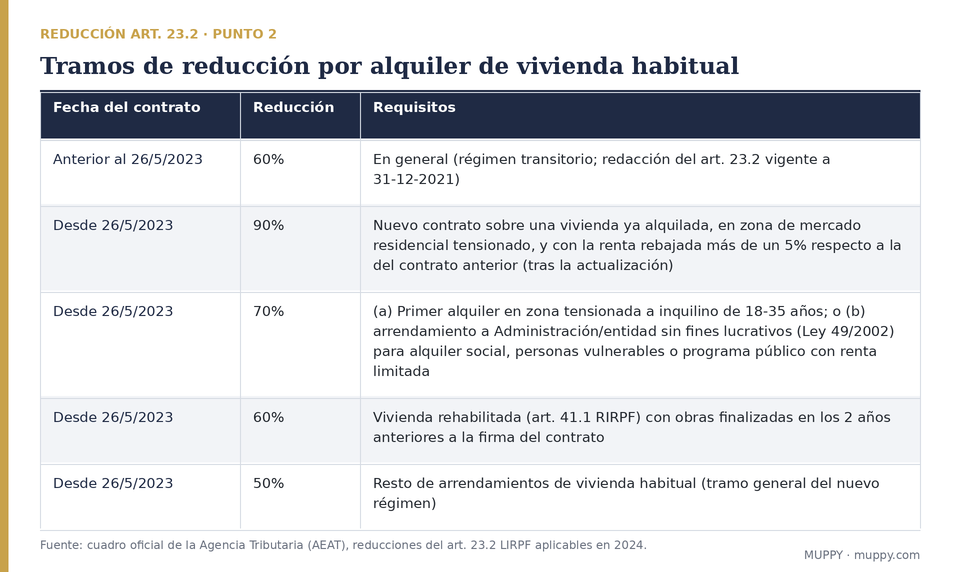
A point that often causes confusion: if your primary residence lease was signed before May 26, 2023, you retain the general 60% reduction from the previous regime as long as that contract remains in effect. In other words, the Housing Law did not suddenly drop everyone to 50%; it respects the 60% rate for contracts already in place. The new range of tiers (90/70/60/50) applies to contracts signed on or after that date. Once that old contract ends and you sign a new one, you will move to the new regime and will need to determine which tier applies to you.
The two highest tiers—90% and 70% (for young tenants)—require the property to be located in a stressed residential market area. This is not something the landlord can self-certify:
The rent adjustment, by the way, is calculated according to the reference index set by current regulations (which has evolved from the CPI to a specific reference index for lease agreements). This index is used to calculate whether or not the new rent represents a reduction of more than 5%.
The order is essential and a common source of errors. First, you calculate gross income; then, you subtract deductible expenses and depreciation (everything in section 1/4 of the cluster) to arrive at the net yield; only then, on the positive net yield, is the reduction under Article 23.2 applied. The reduction is never applied to gross income or before expenses: it is the final step before including the amount in the general tax base and applying the marginal tax rate.
An interesting practical consequence: since the reduction applies to the net amount, the better you optimize expenses and depreciation (lowering the net), the smaller the base on which you apply the reduction... but also the smaller the base that reaches your marginal tax rate. Both levers work in the same direction (lower taxes), which is why it pays to master both.
This is where the power of the incentive lies. The reduction applies to the base that reaches your personal income tax (IRPF) marginal rate, which in high brackets exceeds 45%. Let's start with a net yield of €5,500 and a marginal rate of 45%:
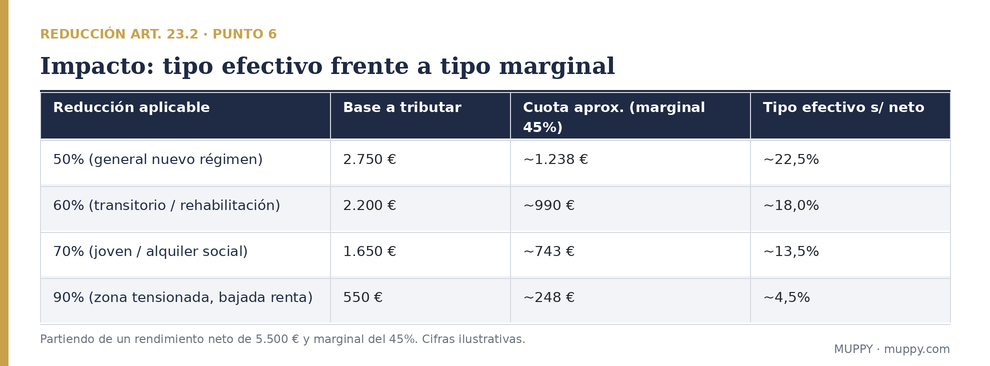
The difference between the 22.5% effective rate of the general tier and the 4.5% of the 90% tier on the same net yield is massive. Multiplied across several assets and sustained over time, that gap between the nominal marginal rate and the effective rate is pure profitability. The property's location (stressed area) and the contract structure (rent reduction, young tenant, social housing) stop being mere administrative details and become strategic decisions for profitability.
Let's combine articles 1 and 2 into a single illustrative example, using a primary residence that generates €12,000 in annual income:
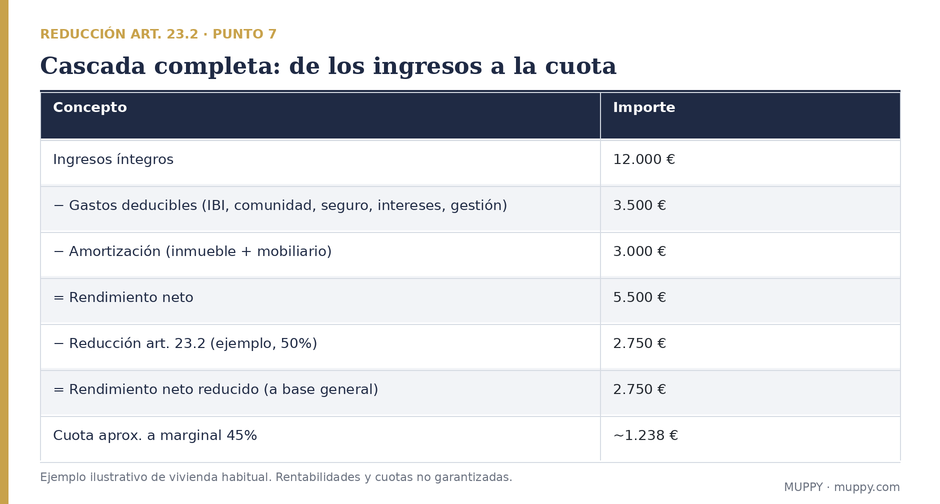
On €12,000 of income, the effective tax is ~€1,238, or about 10% of the income—a far cry from the 45% nominal rate. And if the property were in a stressed area with a rent reduction (the 90% bracket), the taxable base would drop to €550 and the tax due to ~€248: about 2% of the income. That is the scale of what is at stake.
Not all rentals qualify for this reduction, and it is important to be clear about this when designing the strategy for each asset:
This is why the choice of rental type changes more than just gross profitability and operations: it also changes the tax implications. The same property can have a very different tax treatment depending on how it is rented, and that decision must be made with a holistic view (profitability, local regulation, and taxation).
You have a primary residence lease signed in 2021: you keep the 60% rate for as long as it lasts. When it ends and you sign a new one in a non-stressed area, you will move to the 50% general rate. Planning the renewal (is it a stressed area? is there a rent reduction? is the tenant young?) may allow you to secure a better bracket than 50%.
Your property is in a declared rent-controlled area and has been rented out before. If you sign a new contract reducing the rent by more than 5% compared to the previous one (with proof), you qualify for the 90% reduction. While lowering the rent means less income, the jump from a 50% to a 90% reduction can more than compensate for it in terms of net profitability after taxes: it is worth running the full numbers.
For the first rental of a property in a rent-controlled area to a tenant between 18 and 35 years old, you qualify for 70%. This is a significant way to capture a higher bracket without necessarily having to lower the rent as required for the 90% reduction.
For every asset and location, we analyze which model, contract, and conditions allow us to apply—within the bounds of the law—the most favorable reduction bracket, and we incorporate that into the net profitability we present to the investor. Moving a property into the 70% or 90% bracket by meeting the requirements can completely change the after-tax return, and it is the type of decision that an operator with tax expertise provides from the initial analysis of the deal, not at the end.
Which reduction fits your deal? Talk to a Muppy advisor to plan it correctly from the start.
60% for contracts signed before May 26, 2023 (transitional regime); for subsequent contracts, 90%, 70%, 60%, or 50% depending on whether requirements are met regarding stressed areas, rent reductions, tenant age, social housing, or renovations (source: AEAT).
It must be in an area officially declared by the competent authority and in effect on the date of the contract. This is a requirement for the 90% and 70% (young tenant) brackets. Check the list published by your autonomous community.
It is applied to the positive net yield (income minus expenses and depreciation), not to the gross income, and only if the income has been declared correctly.
No, as long as it remains in effect: contracts signed before May 26, 2023, maintain the general 60% rate. When you sign a new one, you move to the current tiered system.
No. Only rentals for the tenant's primary residence qualify. Seasonal or vacation rentals are excluded, although expenses and depreciation can still be deducted.
It depends on the numbers. The discount reduces revenue, but jumping from a 50% to a 90% reduction can more than make up for it in net profit after taxes. Each specific case needs to be calculated.































_1_11zon.webp)