August 4, 2026
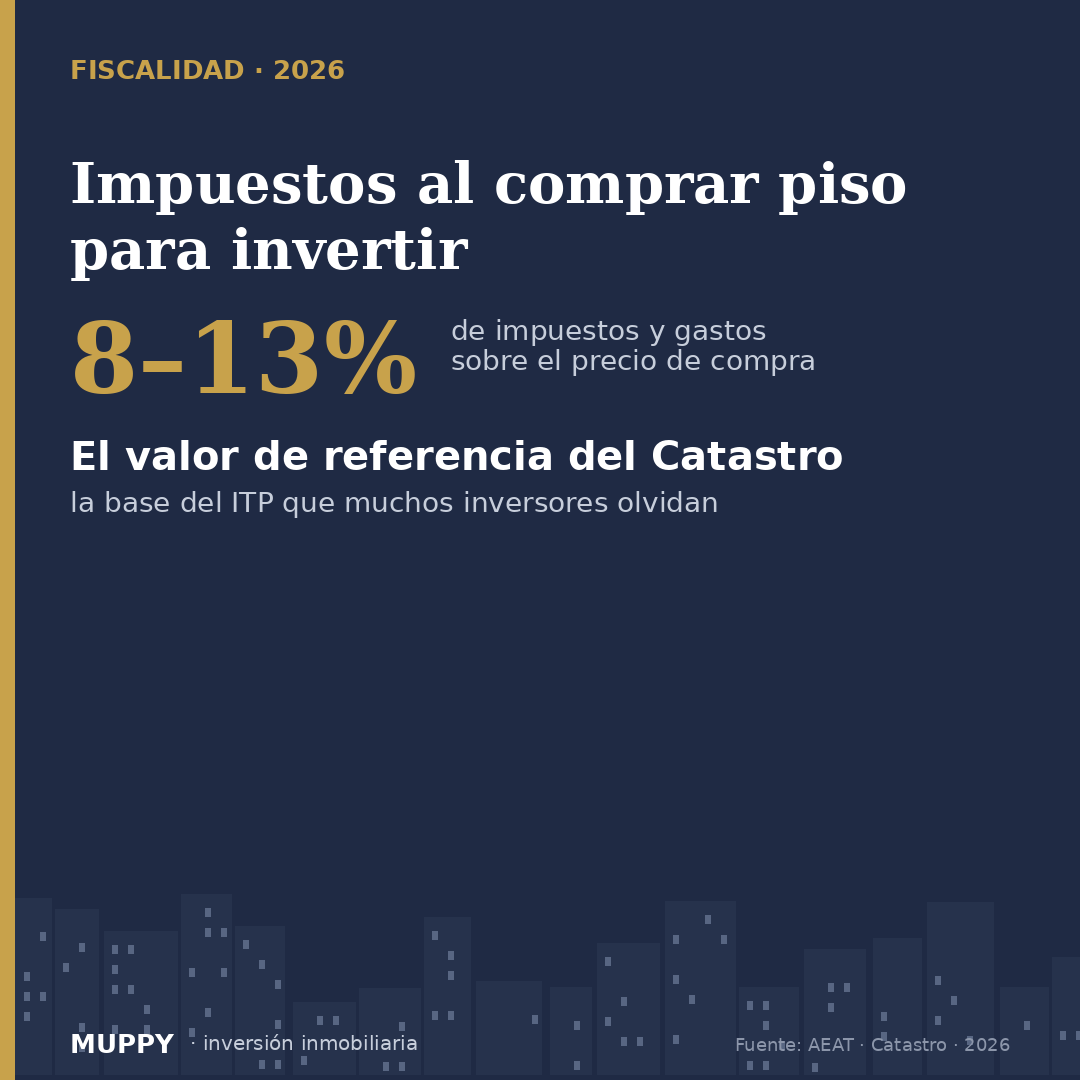
At Muppy we buy and manage properties for investors every week, and one conversation comes up again and again: "the flat costs me X." No, it doesn't. The flat costs you X plus the purchase taxes and fees, which in Spain typically add another 8% to 13% depending on the case. That percentage isn't an administrative detail: it eats into your return from day one, and if you don't budget for it, a deal that looks great on paper becomes a disappointment. This guide gathers, with the detail we wish someone had given us, everything an investor should know about purchase taxes in 2026.
We write it from a dual position: as the people who advise the deal and as the people who execute it on the ground. So beyond the theory, you'll find a complete worked example and the mistakes we see most often.
The main purchase tax depends on whether the property is second-hand or newly built. It's the first variable that completely changes the cost of your investment.
If you buy a resale home, you pay the Transfer Tax (ITP). It's ceded to the autonomous communities, so the rate depends on where the property is: the general rate ranges, as a guide, roughly from 6% to 11% depending on the region, and many territories have reduced rates for young buyers, large families, people with disabilities or based on the property's value. As an investor, this is worth checking market by market, because it can tip the balance between investing in one region or another.
If you buy a newly built home directly from the developer, you don't pay ITP but VAT (10% on housing) plus Stamp Duty (AJD), a smaller percentage also set by each region (usually between 0.5% and 1.5%). In practice, new builds carry a somewhat different tax load than resale homes, and come with other considerations (timelines, guarantees, customization) an investor should weigh.
This is where many investors get it wrong. Since the reform that took effect in recent years, the base on which ITP (and Inheritance and Gift Tax) is calculated is no longer simply the price you pay, but the higher of the declared price and the so-called cadastral reference value.
What does that mean in practice? That even if you negotiate hard and buy below market, the tax authority can calculate the tax on a figure higher than what you paid. And this isn't theory: the courts reaffirmed it in 2026, confirming that the reference value applies even at auctions, where the winning bid tends to be low. For an investor hunting for below-market opportunities, it's a clear warning: the saving on price doesn't always carry over to the tax.
Challenging the reference value generally means paying first and reclaiming afterward, with documentation. Always do it with professional advice.
Beyond the main tax, every purchase carries a set of costs worth budgeting for:
None of these is huge on its own, but added to the taxes they explain why the real cost of acquiring a property is well above the sticker price.
Let's look at it with an illustrative case of a resale home to rent out. The figures are an example to explain the mechanism; your numbers will depend on the region, the property and the moment.
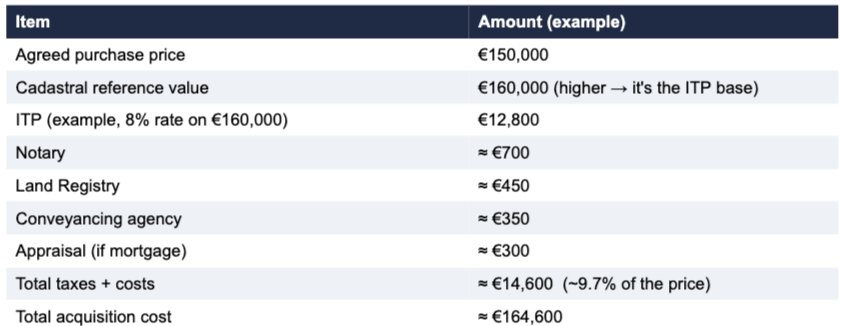
Why does it matter so much? Imagine that flat rents for €800 a month, i.e., €9,600 gross a year. On the purchase price (€150,000), the gross yield would be 6.4%. But on the real total acquisition cost (€164,600) it drops to 5.8%, and it will fall further once you deduct annual costs (property tax, building fees, insurance, maintenance and vacancy) to reach the net yield. The conclusion is the one we always repeat: purchase taxes and costs must be part of the calculation from minute one, not assessed on the price alone.
A common mistake is lumping everything together. It helps to separate three moments:
More and more foreign investors are buying in Spain, especially along the Mediterranean arc. If that's you, there are specifics: you'll need an NIE, the purchase taxes (ITP or VAT) are the same as for a resident, but the subsequent taxation of the rental income is handled through the Non-Resident Income Tax (IRNR). EU residents can deduct costs and are taxed at a reduced rate; non-residents from outside the EU generally cannot deduct costs and are taxed at a higher rate. It's an area where specialized advice makes a real difference to your return.
As an operator, we include purchase taxes and costs in the net-yield calculation of every asset from the very first analysis, never at the end. We check the reference value before committing to a deal, budget notary, registry and conveyancing, and support the investor — resident or not — through the entire tax side of the acquisition. The goal is simple: that there's no gap between what a property seems to cost and what it actually costs, and that the yield we show you is the real one.
Want to see the real cost and net yield of a deal? Our calculator helps you estimate it including taxes and costs, and an advisor can review your specific case and region.
It depends on whether it's a new build (10% VAT + AJD) or second-hand (ITP, roughly 6% to 11% depending on the region). Adding notary, registry and conveyancing, the extra cost usually lands around 8%-13% of the price.
It's an administrative value that acts as a minimum base for ITP and Inheritance and Gift Tax. If it's higher than the price you pay, the tax is calculated on it, even if you buy cheaper (including at auctions). Check it before signing.
Yes. Generally you self-assess the tax and then request a rectification, providing evidence (such as an appraisal) that the real value is below the reference value. It's advisable to do it with professional advice.
There's no single answer: resale pays ITP (variable regional rate) and new build pays VAT (10%) plus AJD. The specific load depends on the region and the property; you have to run both scenarios.
The purchase taxes (ITP or VAT) are the same as for a resident, and you'll need an NIE. The difference comes later, in the taxation of rental income through the IRNR, which varies depending on whether you're an EU resident or from outside the EU.
A lot. In this guide's example, including taxes and costs cut the gross yield from 6.4% to 5.8% even before deducting annual costs. That's why they must be part of the calculation from the start.