

September 2, 2026
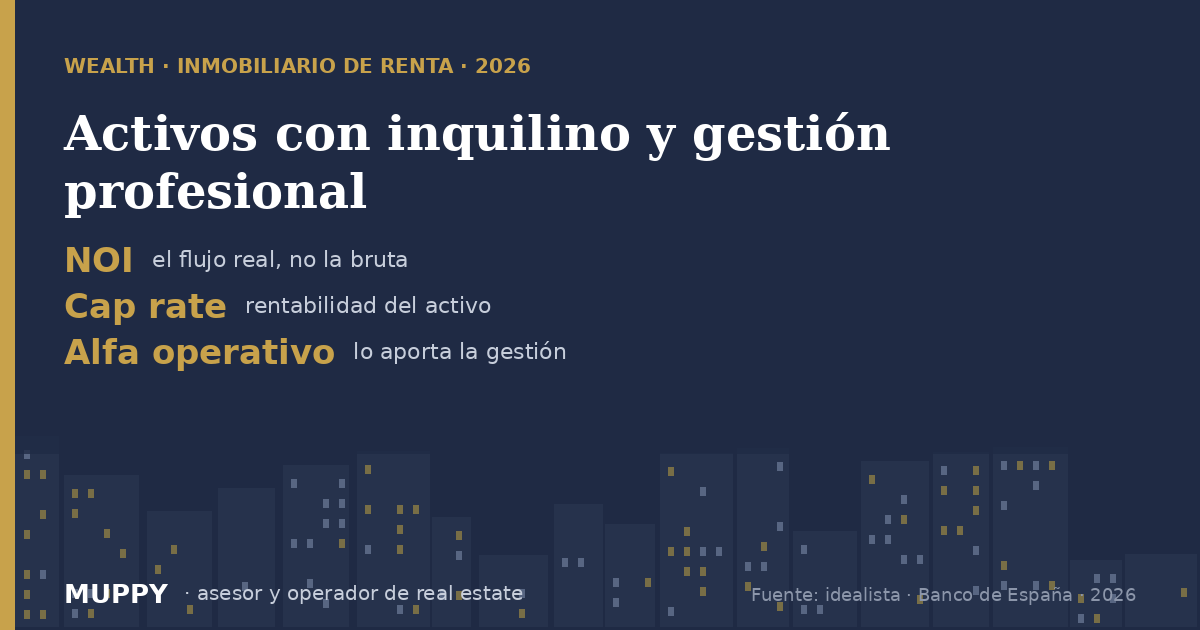
There is a type of real estate investment that rarely makes headlines, yet it captures a significant portion of serious private capital: income-producing assets managed by a professional third party. This isn't about speculative "buy low, sell high" tactics or the weekend hobby of flipping apartments. It is, quite simply, the most efficient way to turn real estate into a stable, leverageable, and nearly passive income stream. In the context of 2026—with prices at record highs, interest rates elevated, and regulations that penalize amateurs—it has never made more sense.
This article is written for the wealth investor who already understands that profitability isn't found in a brochure, but in the actual numbers. We are going to get technical, look at the figures, and anchor our analysis to what is happening in the market right now, from the perspective of an operator who does this every day.
An income-producing asset is, quite literally, a property that is already generating revenue: it is rented (or ready to be rented immediately) and produces cash flow from day one. In the industry, this is known as income-producing real estate. The difference between this and buying a property to renovate, find a tenant, and wait is massive: you eliminate the startup period (the lease-up), reduce uncertainty, and transform the property into what wealth investors truly seek—an asset that yields returns from the very first minute.
For a wealth investor, this matters because it changes the investment profile: from a project with execution risk to an income asset with visible cash flows. And visible cash flows are the foundation upon which lasting wealth is built.
This is where we separate those who invest with criteria from those who buy on intuition. Gross yield—annual rent divided by price—is a marketing number. The wealth investor works with metrics that reflect the asset's operational reality:
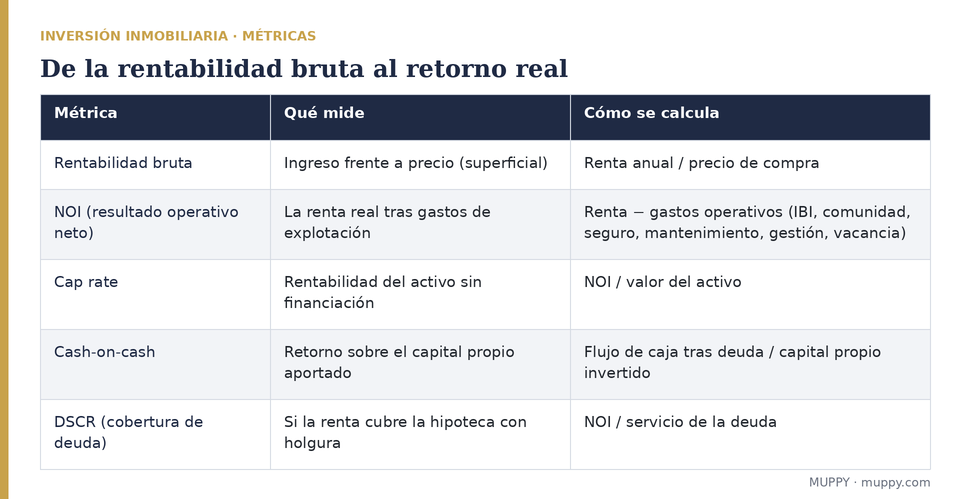
The gap between gross yield and these metrics is what we in the industry call "gross-to-net leakage": everything that slips away between the theoretical income and the euro that actually reaches your pocket. Taxes, community fees, insurance, maintenance, vacancy periods, delinquency, and management. A well-managed income-producing asset minimizes this leakage; a poorly managed one causes it to skyrocket.
An example with numbers (illustrative)
Let’s assume an income-producing asset worth €200,000 that generates €12,000 in annual rent (a 6% gross yield). Annual operating expenses (property tax, community fees, insurance, maintenance, management, and a vacancy provision) total €3,000. The NOI is €9,000, resulting in a 4.5% cap rate. If we finance 60% (€120,000) at a rate of around 3%, with debt service of about €6,000 per year, the DSCR is 1.5x (the rent covers the mortgage with a margin). The cash flow after debt is €3,000; on an equity investment of about €100,000 (down payment plus taxes and expenses), the cash-on-cash return is around 3%, to which we add the mortgage principal amortization and the asset's appreciation. These are illustrative figures, but they show the mechanism: the total return of an income-producing asset is composed of rent, amortization, and appreciation, not just a single number.
Illustrative example to explain the method; actual numbers depend on the asset, city, financing, and timing. Returns are not guaranteed.
Leverage is the tool that turns a 4.5% cap rate into a much higher return on equity, provided one condition is met: the asset's yield must comfortably exceed the cost of financing. And this is where current events dictate the terms. The Euribor closed June 2026 at around 2.8%, its highest level since September 2024, and benchmark fixed rates hovered between approximately 2.55% and 3.20%. With that cost, the margin for error narrows: the asset must be bought well and managed well for leverage to work in your favor.
Data confirms that the market is already exercising caution. According to the Bank of Spain, both high-risk mortgages and the average percentage financed fell in the first quarter of 2026 to levels not seen since late 2024. People are buying with more savings and less debt. For the wealth investor, the takeaway is clear: leverage remains a powerful tool, but it requires an asset with solid cash flows and a comfortable DSCR. An income-producing asset, precisely, offers those flows from day one.
This is the central thesis of this article. In an income asset, the realized return is determined less by the purchase and more by the subsequent management. Vacancy, delinquency, tenant turnover, maintenance, regulatory compliance, and price optimization between contracts are the factors that create—or destroy—net profitability. This is what we in the industry call operational alpha: the value that a professional manager adds beyond simple asset ownership.
For the wealth investor, delegating management to a professional third party is not a convenience; it is a decision about profitability and risk. A specialized operator reduces vacancy (through qualified demand and predictable turnover), controls delinquency (through tenant screening), contains maintenance costs (through processes and vendors), and ensures compliance with increasingly complex regulations. All of this translates directly into a higher and more stable NOI. In other words: professional management is what closes the gap between gross and net profitability.
There is a second dimension: time. Your wealth shouldn't depend on you becoming a part-time property manager. Third-party management turns real estate into a truly passive asset for the investor, while you retain direct ownership and strategic control. It is the only way to scale—holding multiple assets across different cities without the operations becoming unmanageable.
No strategy is good in a vacuum; it is only good within a context. And the 2026 landscape strongly favors tenanted assets and professional management:
The Muppy vision: In a market like this, the winning investor isn't the one who times the market perfectly, but the one who buys assets with real cash flows and places them in the hands of professional operators. Today, profitability is defended through management.
Beyond the individual transaction, a tenanted asset serves a portfolio function. It provides recurring income (which cushions overall volatility), real diversification from financial assets (with a different correlation to the stock market), and inflation protection (prices and rents tend to track the cost of living). In exchange, it requires accepting an illiquidity premium: real estate cannot be sold with a single click, and that illiquidity is, in part, the source of its superior returns. For a long-term wealth horizon, that premium is an advantage, not a flaw.
The proportion of a portfolio allocated to income-generating real estate depends on liquidity, time horizon, and risk profile. But its role remains the same: the stable, income-generating core of the portfolio.
Muppy is built precisely on this thesis: tenanted assets with professional management, with the investor as the direct owner. We select properties with potential for yield and appreciation using our proprietary valuation model, place them on the rental market, and manage the entire cycle—vacancy, maintenance, tenants, compliance, and price optimization—to maximize NOI and stabilize cash flows. The investor receives the net return and reporting, without any operational burden, with the property in their name. It is the model sought by those who want real estate to be the core income generator of their wealth without becoming property managers: over 150 million euros in assets under management, more than 350 investors, and a presence in five metropolitan areas back this up.
Do you want to add income-generating assets to your portfolio? Calculate the net return of an operation with our calculator and speak with an advisor to design a portfolio of managed, tenanted assets from start to finish.
It is a property that is already rented or ready to be rented immediately, generating income from day one. It eliminates the startup period and turns the investment into an asset with visible cash flows.
NOI (income minus operating expenses), cap rate (NOI over asset value), cash-on-cash (return on your equity), and DSCR (whether the rent comfortably covers the mortgage). These are the metrics that reflect the actual return.
Because in an income-generating asset, the realized return depends primarily on management (vacancy, delinquency, maintenance, compliance). A professional operator generates "operational alpha," closes the gap between gross and net yield, and turns real estate into a passive asset for the investor.
Yes, if the asset's yield comfortably exceeds the cost of debt and the DSCR is comfortable. With Euribor around 2.8%, the asset must have solid cash flows; a tenanted asset offers them from day one.
It depends on your liquidity, time horizon, and risk profile. It typically serves as the stable, income-generating core of a portfolio; it is best to determine the right size with professional advice.
Sources: housing and rental prices, idealista (May-June 2026); Euribor and financing, idealista and Bank of Spain (Q1-2026); supply analysis, Bank of Spain and research centers (2026). Figures subject to update.































_2_11zon.jpg)